
Complete Guide to Fans & Ventilation in Malaysia (2026)
⚡ TL;DR
- Choosing the wrong fan type, blade count, or motor for your space wastes energy and fails to ventilate effectively.
- KDK and Panasonic ceiling fans outperform no-brand alternatives in motor longevity, energy efficiency, and after-sales support.
- See Kwong Electric supplies ceiling fans, industrial fans and exhaust ventilation systems in Ipoh — with expert advice on what suits your space.
Table of Contents
1. AC vs DC Motors — What's the Difference?
2. 3 vs 4 vs 5 Blade Ceiling Fans — Does It Actually Matter?
3. Why Choose KDK or Panasonic Over No-Brand Fans?
4. Kitchen Ventilation Strategy: Cooker Hoods vs Exhaust Fans
5. Low vs High Ceilings — How Long Should Your Downrod Be?
6. How to Calculate Exhaust Fans for Factories & Commercial Kitchens
7. Wall-Mounted Industrial Fans vs Floor Blowers
8. Industrial Fan Maintenance — Preventing Motor Burnout
9. Frequently Asked Questions
10. Shop Fans & Exhaust at See Kwong Electric
---
1. AC vs DC Motors — What's the Difference?
The motor is the heart of any ceiling fan — and the choice between AC (alternating current) and DC (direct current) motors affects everything from energy consumption to noise level and speed control.
AC motors are the traditional standard — reliable, lower upfront cost, and widely serviced in Malaysia. DC motors are newer, consuming up to 70% less electricity than equivalent AC models, running significantly quieter, and offering more speed settings.
For daily-use home environments and energy-conscious commercial spaces, DC motor fans deliver a measurable long-term saving on electricity bills.
The tradeoff: DC motor fans carry a higher purchase price. For high-ceiling commercial spaces where fans run continuously, the payback period is typically shorter and the efficiency gains more significant.
→ Guide coming soon. WhatsApp us at 016-5261333 if you need
advice on this now.
---
2. 3 vs 4 vs 5 Blade Ceiling Fans — Does It Actually Matter?
Blade count is one of the most misunderstood specs in ceiling fan selection. The common assumption is that more blades means more airflow — this is not accurate.
3-blade fans are lighter and faster-spinning, suited for smaller rooms and modern aesthetics. 4-blade fans balance airflow and noise, making them the most common choice for Malaysian homes.
5-blade fans move air more quietly but generate slightly less airflow per watt — better for bedrooms where silence matters more than maximum circulation.
What actually matters more than blade count: blade pitch (angle), blade span (diameter), and motor power. A quality 3-blade fan from KDK will outperform a generic 5-blade fan on every meaningful metric.
→ Guide coming soon. WhatsApp us at 016-5261333 if you need advice on this now.
---
3. Why Choose KDK or Panasonic Over No-Brand Fans?
The Malaysian market is flooded with unbranded ceiling fans at attractive price points. The real cost only becomes clear 12 to 24 months later — capacitor failures, bearing noise, motor burnout, and unavailable replacement parts.
KDK and Panasonic ceiling fans are engineered to Malaysia's climate — high ambient temperatures, continuous operation, and humidity levels that degrade cheaper motor windings rapidly.
Both brands carry manufacturer warranties, established service networks, and spare parts availability across Malaysia.
For contractors supplying fans to developers or homeowners, specifying KDK or Panasonic eliminates callback risk. For homeowners, it means a fan that runs quietly and reliably for a decade rather than one that rattles within a year.
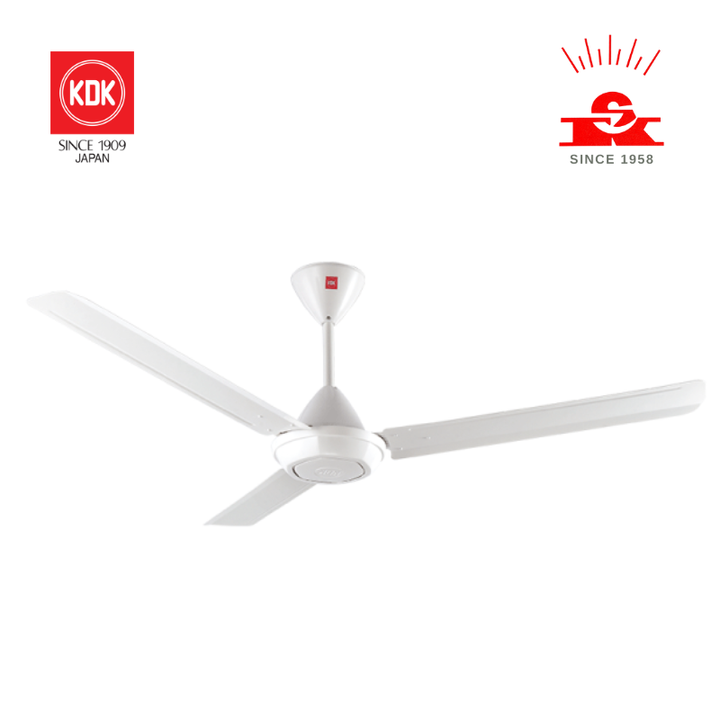
See Kwong Electric is a stocking dealer for KDK ceiling fans in Ipoh. We carry a full range of models across blade spans and motor types.
→ Guide coming soon. WhatsApp us at 016-5261333 if you need
advice on this now.
---
4. Kitchen Ventilation Strategy: Cooker Hoods vs Exhaust Fans
Many Malaysian homeowners and F&B operators make the same mistake — installing a cooker hood above the stove and assuming ventilation is solved. It isn't.
A cooker hood captures grease and steam at the source but recirculates filtered air unless ducted externally. An exhaust fan removes stale, humid, and odour-laden air from the kitchen entirely. The most effective kitchen ventilation strategy uses both in tandem: cooker hood for source capture, exhaust fan for overall air turnover.
For commercial kitchens — restaurants, food courts, and institutional canteens — this balance is not optional. Inadequate exhaust leads to heat buildup, condensation, grease accumulation, and failed health inspections.
The correct exhaust fan sizing for a commercial kitchen depends on kitchen volume, cooking intensity, and air changes per hour (ACH) required. See Kwong Electric can advise on the right exhaust specification for your kitchen layout.
→ Guide coming soon. WhatsApp us at 016-5261333 if you need advice on this now.
---
5. Low vs High Ceilings — How Long Should Your Downrod Be?
A ceiling fan hung at the wrong height is either a safety hazard or an ineffective air mover. The optimum fan blade
height for air circulation in Malaysian homes is 2.4m to 2.7m from the floor.
For standard 3m ceilings, a short downrod of 15cm to 20cm is typically sufficient. For higher ceilings — common in commercial spaces, double-volume living areas, and older shophouses — a longer downrod is required to bring the fan into the effective circulation zone.
For very low ceilings (below 2.6m), flush-mount or hugging-mount fans without a downrod are the correct
specification — standard downrod installations at this height create a head-strike hazard and poor air distribution.
Getting the downrod length wrong doesn't just look awkward — it means the fan circulates air at the wrong
level entirely, leaving occupants in still air while the ceiling zone is ventilated.
→ Guide coming soon. WhatsApp us at 016-5261333 if you need
advice on this now.
---
6. How to Calculate Exhaust Fans for Factories & Commercial Kitchens
Under-ventilated industrial and commercial spaces are uncomfortable, inefficient, and in some cases non-compliant with DOSH (Department of Occupational Safety and Health) workplace air quality requirements.
The standard calculation method uses Air Changes per Hour
(ACH):
Required CFM = (Room Volume in cubic feet × ACH) ÷ 60
ACH benchmarks for Malaysian commercial spaces:
- Standard factory floor: 20–30 ACH
- Commercial kitchen: 30–60 ACH
- Warehouse: 6–10 ACH
- Server room: 20–30 ACH
From this figure, you determine the number and capacity of exhaust fans required to achieve the target air change
rate. Undercounting fans — or oversizing individual units without accounting for intake airflow — are the two most common errors in industrial ventilation planning.
See Kwong Electric stocks YET industrial exhaust fans across a range of capacities suitable for factory and commercial kitchen ventilation. WhatsApp us with your floor area and ceiling height for a recommendation.
→ Guide coming soon. WhatsApp us at 016-5261333 if you need advice on this now.
---
7. Wall-Mounted Industrial Fans vs Floor Fans/ Blowers
For open industrial workspaces — factories, warehouses, workshops — the choice between wall-mounted fans and floor blowers significantly affects both airflow coverage and operational flexibility.
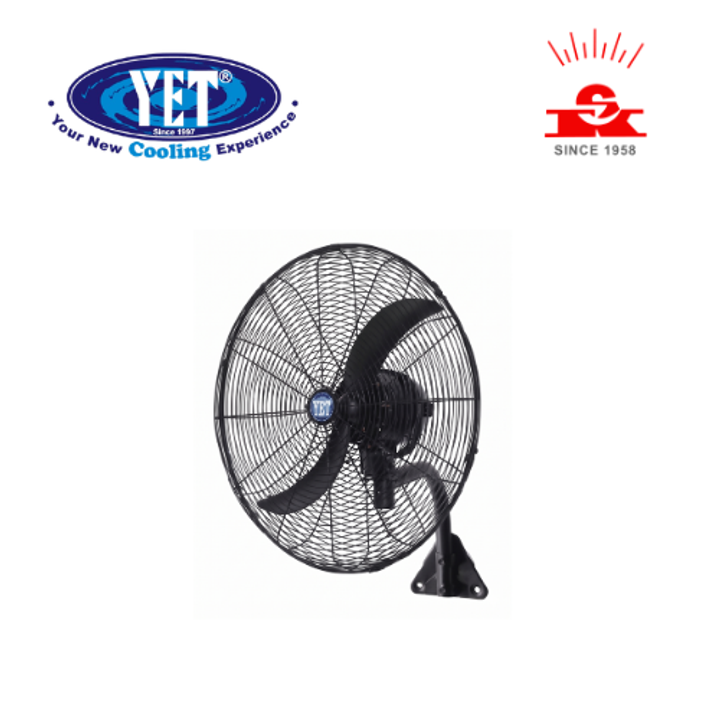
Wall-mounted industrial fans provide fixed, directional airflow across a defined zone. They free up floor space, are suitable for permanent workstation cooling, and reduce trip hazards in busy production environments.
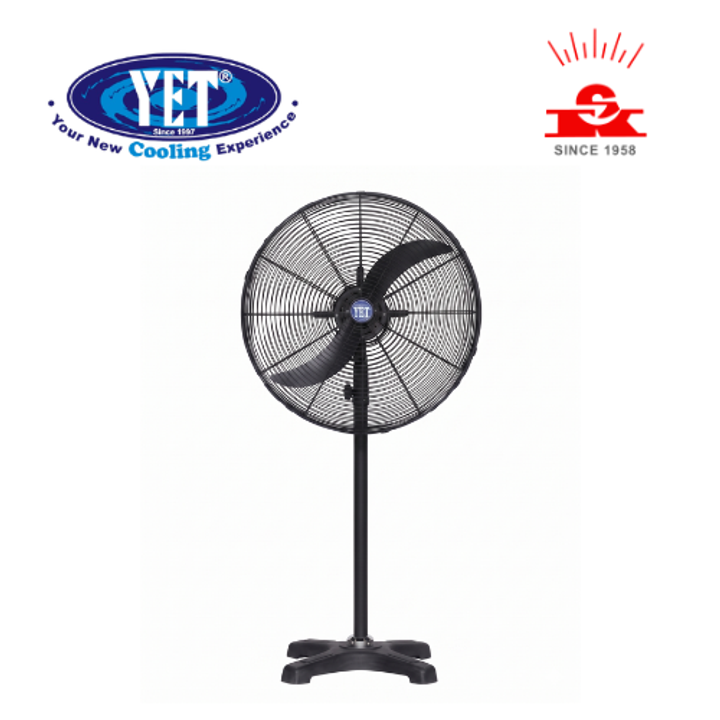
YET wall-mounted fans are a proven specification for Malaysian factory environments. Floor blowers (drum fans or barrel fans) offer portability — they can be repositioned as workflow changes, directed at specific heat sources, or used temporarily during construction or renovation. The tradeoff is floor space, cable management, and vulnerability to being knocked over in active production areas.
For most permanent factory installations, wall-mounted is the correct long-term specification. Floor blowers are best used as supplementary or temporary units.
→ Guide coming soon. WhatsApp us at 016-5261333 if you need advice on this now.
---
8. Industrial Fan Maintenance — Preventing Motor Burnout
An industrial fan running in a Malaysian factory environment faces continuous heat, dust, and humidity — conditions that accelerate motor wear if maintenance is neglected.
The most common cause of premature industrial fan motor failure is bearing wear from accumulated dust and lack of lubrication. The second most common is capacitor degradation — the capacitor is the component that starts and regulates the motor, and it degrades faster in high-heat environments.
Basic maintenance schedule for industrial fans:
- Monthly: Clear dust from blade surfaces and motor housing. Check for unusual vibration or noise.
- Quarterly: Inspect motor mounting bolts for loosening. Check blade balance — an unbalanced blade accelerates bearing wear.
- Annually: Lubricate bearings where accessible. Inspect capacitor and wiring connections. Replace worn components before motor failure occurs.
Reactive replacement after motor burnout costs significantly more than scheduled maintenance — factoring in downtime, emergency procurement, and installation.
See Kwong Electric stocks Industrial Fan WhatsApp 016-5261333 for parts availability.
→ Guide coming soon. WhatsApp us at 016-5261333 if you need advice on this now.
---
Frequently Asked Questions
Q: What ceiling fan brand is best for Malaysian homes?
KDK and Panasonic are the two most reliable ceiling fan brands available in Malaysia. Both are engineered for continuous tropical operation, carry manufacturer warranties, and have established service networks.
See Kwong Electric stocks KDK ceiling fans in Ipoh.
Q: What is a DC motor ceiling fan and is it worth it?
A DC motor ceiling fan uses up to 70% less electricity than a standard AC motor fan and runs significantly quieter. For bedrooms and daily-use living spaces, the energy saving justifies the higher upfront cost over a typical 5–7 year payback period.
Q: How many exhaust fans does my factory need?
The number depends on your floor area, ceiling height, and required air changes per hour (ACH) for your industry type.
Q: What is the correct downrod length for a 3.5m ceiling?
For a 3.5m ceiling, a downrod of approximately 30cm to 45cm typically positions the fan blades at the optimal 2.4m to 2.7m circulation height. Exact length depends on the specific fan model's canopy and motor housing depth.
Q: Are neoprene flexible cables needed for industrial fan wiring?
For industrial fans installed in environments with oil, heat, or outdoor exposure, neoprene sheathed
flexible cables are the correct specification. Available from See Kwong Electric on pre-order — contact us early to factor in lead time.
---
Shop Fans & Exhaust at See Kwong Electric
See Kwong Electric has supplied ceiling fans, industrial fans, and exhaust ventilation systems to homeowners, contractors, and facility managers across Perak for over 60 years.
Stocked items include:
- KDK ceiling fans — full range of blade spans and motor types
- YET industrial wall-mounted fans and exhaust fans
- Domestic exhaust fans for kitchens and bathrooms
📦 View our full Fans & Exhaust range:
[seekwong.com/collections/fan-exhaust]
📞 Need a quote or ventilation advice? WhatsApp us at
016-5261333 or visit us at:
177, Jalan Pasir Puteh, Taman Hoover, 31650 Ipoh, Perak
Monday – Saturday | 8:30am – 5:00pm